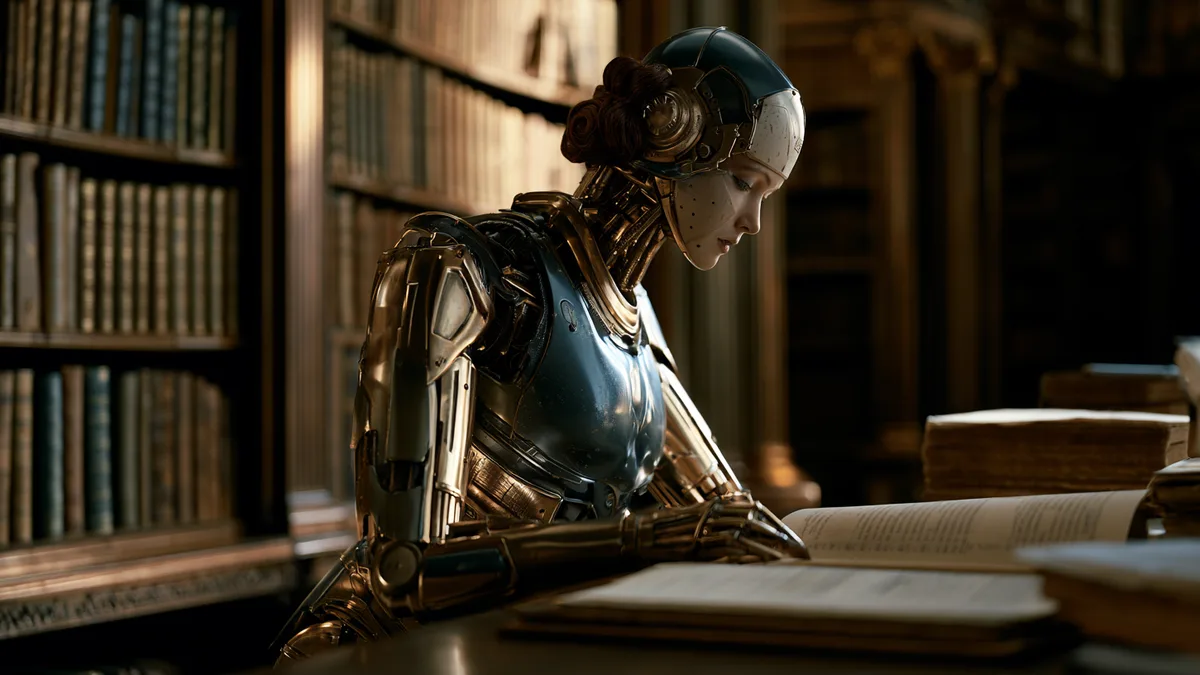
For two hundred years, genealogy has been a craft of patience. You write to a parish. You squint at a census taken by a clerk with bad handwriting. You drive to a county archive and turn brittle pages until your eyes ache. The finding has always been the hard part. Most of the work of family history is not knowing your great-grandmother; it is locating the one record that proves she existed.
That is about to change, and faster than most people expect.
The genealogist in your pocket
A new kind of assistant is arriving. Give an AI agent access to digitised archives, scanned registers and the growing ocean of records on the open web, and it will do in an afternoon what used to take a determined amateur a decade. It will read the bad handwriting. It will cross-check a baptism against a marriage against a ship's manifest. It will notice that the Wilhelm in the 1888 parish book and the Wilhelm in the 1910 census are the same man, and tell you why it thinks so.
This is genuinely good news. The barrier that kept ordinary families from knowing their own past, the sheer grinding labour of it, is coming down. Soon almost anyone will be able to ask a capable assistant to trace a line and watch the names come back.
But a quiet problem hides inside the good news. When finding becomes easy, finding stops being the point. The new hard question is the one genealogists have always answered badly: once you have found your people, where do you keep them?
Where the work goes to die
Think about what an agent actually produces. A stream of facts. A name, a date, a place, a source. Dozens of them, then hundreds. If that stream lands in a chat window, it is already half lost. Chat histories scroll away. They are not a tree. You cannot hand your cousin a conversation and say, here is our family.
If instead it lands inside one of the big subscription sites, you have traded one cage for another. Your agent did the work, but the result now lives somewhere that charges you every year to keep looking at it, and locks it the day you stop paying. The labour was yours. The data is theirs.
This is the trap the next few years will spring on a lot of families. The research will get cheap and abundant, and people will pour it into whatever window is closest, and in ten years they will discover that the most valuable thing they own, the gathered memory of everyone they came from, is sitting in a format they cannot move and a service they cannot leave.
What an AI genealogist can actually do
It helps to be concrete, because the abstract promise of "AI will help" hides how much is genuinely about to change. Picture handing a capable agent a single starting point: your name, your parents, the town a grandparent came from. Here is the kind of work it can now take off your hands.
It reads the unreadable. A census taker in 1881 wrote three hundred names in a hand that has defeated every human who tried since. Modern models trained on historical scripts can transcribe that page in seconds, including the crossings-out and the marginal notes that often hold the real story. The same goes for parish registers in Latin, ship manifests in faded ink, military rolls, probate inventories, the whole paper sea that genealogy swims in.
It reasons across sources. The hard part of family history was never reading one record. It was deciding whether the Maria Schmidt baptised in one village in 1840 is the Maria Schmidt who married two towns over in 1862 and the Maria who died, a grandmother of nine, in 1911. A person weighs the dates, the places, the witnesses, the naming patterns, and makes a judgement. An agent can hold all of those threads at once, lay out the case for and against a match, and tell you how confident it is and why. That is the actual labour of genealogy, and it is exactly the kind of patient cross-referencing that machines are now good at.
It never gets tired and never gets bored. The reason most family trees stall at the third or fourth generation is not that the records run out. It is that the work is repetitive and slow, and life is short. An agent will chase the same fading trail for the thousandth time with the same care it gave the first, through the night, across a dozen archives in four languages, and surface in the morning with a list of leads and the evidence behind each one.
None of this removes you from the picture. It changes your job. You stop being the clerk who squints at microfilm and become the editor who decides what to trust, what to keep, and what story it all tells. That is a better job. It is also a job that still needs somewhere to put the work.
The home is the thing
So the centre of gravity shifts. In a world where anyone can find ancestors, the prize is not the finding. It is having somewhere worthy to put them: a single, canonical record of your family that is permanent, private by default, beautiful enough to be proud of, and yours to carry anywhere.
Permanent, so the work compounds instead of evaporating. Private, because most of the people in a living family tree are alive, and they did not consent to being published. Beautiful, because a family is not a spreadsheet and deserves better than to be shown as one. And portable above all, because the only real protection against any single company, including the one that builds your home, is the unconditional right to walk out with everything.
That last point is the whole game. A home you cannot leave is not a home. It is a vault with you inside it.
What owning your family tree really means
People say they want to own their data, but the word has been worn smooth by overuse. In genealogy it has a precise and testable meaning, and it comes down to one humble file format.
GEDCOM is the plain-text standard that every serious genealogy program can read and write. It holds your people, their dates and places, their marriages and notes, in a form no single company controls. Owning your tree means you can produce a complete GEDCOM of everything, in one click, whenever you like, with no permission asked and no fee charged. If you can do that, you are free. If you cannot, you are renting, however it is dressed up.
This is the test to apply to any home for your research, including the new ones being built for the AI era. When an agent pours a thousand hard-won facts into a service, ask the simple question: can you get all of them back out, intact, tomorrow, and walk away? On the big subscription sites the honest answer has long been no, or not without a struggle, or not once your subscription lapses. That is the trap, and it does not disappear just because the data arrived by a cleverer route. A tree an agent built for you is only truly yours if you can leave with it.
Portability is not a feature you will use often. Most people never export anything. It matters the way a fire exit matters. You want it there, unlocked, the day you need it, and a home that hides the exit is telling you something about how it sees you.
Bring your own agent
This is the thinking behind the Dynasty House family tree API. We decided early that we did not want to be the company that owns your research. We want to be the place it lives.
So the door is open. Any agent you trust, Claude or otherwise, can be handed a key and pointed at your tree. It reads the whole family in a single call, so it always knows what is already there. It writes new people back, links them as a parent or a child or a spouse, and records where it found them. The moment it does, the person appears in your tree the way every other person does: on the pan-and-zoom chart, on the time wheel, with a life story and a place on the family page you can share. Living relatives stay hidden automatically, the way they always are.
The integrity rules that protect your tree inside the app protect it through the API too, so an agent working at speed cannot quietly corrupt the structure. And the export stays exactly where it has always been: one click, free, the complete GEDCOM, no permission needed. The tree your agent builds is yours in the only sense that matters, which is that you can take it and go.
How it works in practice
The mechanics are deliberately plain, because a tool meant for agents should be boring and predictable. A genealogy API does not need to be clever. It needs to be honest about what a family is and get out of the way.
An agent is given a key that belongs to you and nobody else. With it, it can read your whole tree in a single call: every person, every partnership, every parent-and-child link, returned as plain structured data it can reason over. When it finds someone new, it writes them back, and says how they connect, as a parent or a child or a spouse of someone already there. The connective tissue, the marriages and the descents, is handled for it, so it cannot accidentally tangle the shape of your family.
Then it does the part that turns a name into a person. It writes their story into a biography. It records the milestones a life is actually made of, the move to a new town, the trade they took up, the war they were caught in, the ship that carried them across an ocean. It can attach a face, fetching a portrait it found in a digitised collection and pinning it to the right person. Everything it adds appears in your tree the moment it lands, on the pan-and-zoom chart, on the timeline, on the family page you can share, exactly as if a relative had typed it in by hand.
That is the whole idea of a family tree API in the age of agents. Not a walled garden with a developer programme and a sales call, but an open door: bring the assistant you already trust, point it at your own tree, and let it work.
The discipline that turns a guess into a record
There is a real danger in all of this, and it would be dishonest to skip it. A model that can write a beautiful biography can also write a beautiful lie. Left unchecked, an eager agent will smooth over a gap with a plausible invention, and a plausible invention, written into a family tree and shared with relatives, can harden into a false fact that outlives everyone who could have corrected it.
So the rule that matters more than any other is simple to say and hard to hold: record only what the records support, and write down where each thing came from. A good agent, and a good home for its work, treats every claim as something that must be sourced. The parish register, the page number, the census year. Not because it is tidy, but because a family history is only worth keeping if a great-grandchild can one day trace it back and trust it.
This is the quiet difference between a pile of AI output and a genealogy. One is a guess dressed up as a memory. The other is a chain of evidence you can follow back into the dark. The tools are finally good enough to build the second thing at scale. Whether we do depends entirely on the discipline we bring, and on choosing a home that keeps the sources attached to the facts rather than letting them drift apart.
A simple division of labour
There is an old saying that in a gold rush, the money is in selling pickaxes. It is half right. The other half is owning the gallery where people hang what they found.
Let the agents do the digging. They are about to be extraordinary at it. Keep the gold somewhere it will still be safe, and still be beautiful, and still be yours, long after this year's tools are forgotten. That is the part we are building, and it is the part that lasts.
The research is becoming a commodity. The home for it is not. Choose the home carefully, because unlike the finding, you only get to do it once.